BCPEA Sales
- Official notice board
- Access not confirmed
Visit official website sales.bcpea.orgCompare with another platform
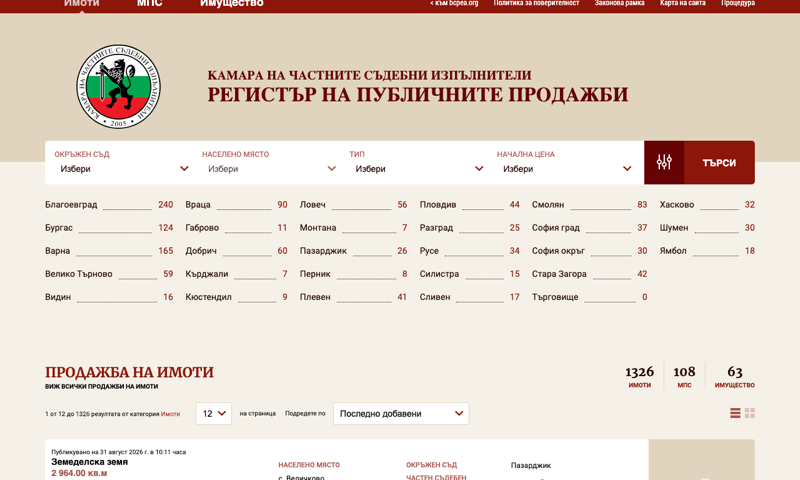
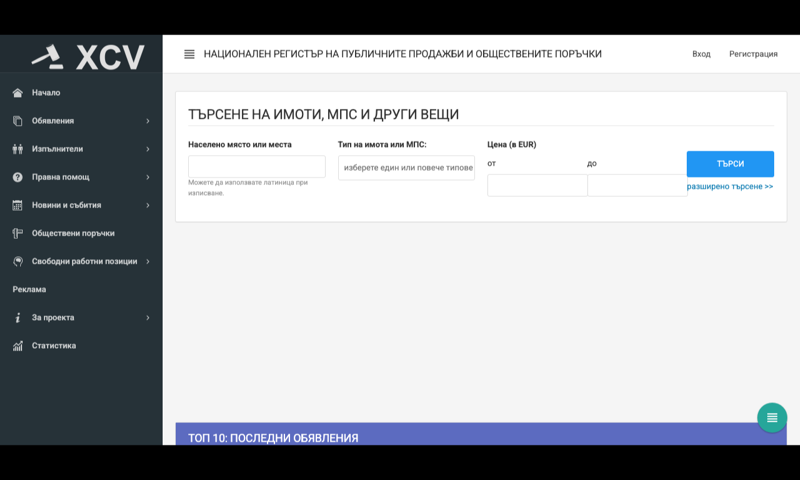
BCPEA Sales is the official register of enforcement sales in Bulgaria, published by the Chamber of Private Enforcement Agents (Камара на частните съдебни изпълнители), which every Bulgarian private bailiff must join. Almost everything on it was seized in enforcement proceedings and is sold by a named agent under a regional court, though the register also carries a filter for voluntary sales. It is a publication register, not a bidding platform — offers are filed on paper, not through the site. Roughly 1,300 properties, 100 vehicles and 60 movable lots are live at once.
What you can buy
- Residential property: one- to four-room apartments, maisonettes, attic studios, village houses, single floors of houses, villas, garages.
- Land: farmland is the largest single category — around half of all listings — from small village plots to parcels of several hectares, plus building plots.
- Commercial and industrial real estate: shops, offices, restaurants, warehouses, factories, hotels, petrol and LPG stations, car washes.
- Vehicles: used Audi, Mercedes, Renault and similar cars, vans, trucks, motorcycles, caravans, trailers and semi-trailers.
- Machinery and movables: tractors, potato harvesters, ploughs, seed drills, forklifts, hydraulic presses, welding sets, CNC robots, plus tools, appliances, furniture, jewellery and artwork.
How the bidding works
There is no account to create and no live bidding screen. Each listing carries a bidding window — normally one calendar month — and names the enforcement agent, the regional court and the settlement where the asset sits. To take part you pay a deposit of 10% of the announced starting price into that agent's account, so that it clears before the auction day, then file a sealed written offer at the registry of the local district court before the window closes. Each bidder gets one offer per lot, and it may not fall below the starting price or exceed it by more than 30%. The agent opens the envelopes at the published time the following day, in the court building, and announces the highest bid; a tie for the highest price is settled by drawing lots, and any bidder present may then raise the price by one deposit step, which opens an oral round. The winner has two weeks to pay the balance or forfeits the deposit, the runner-up then becoming buyer. Individuals and companies may both bid; the debtor, his legal representative, the court registry staff and the agent's own employees may not. Starting prices are a set percentage of the enforcement valuation, and a re-run sale opens at 90% of the first sale's price.
What to check before you bid
The filters work, but the document that matters — the sale announcement — is a scanned Bulgarian PDF with no text layer, so it cannot be copied or machine-translated as it stands, and the site has no English version. Budget for a translator or a Bulgarian lawyer. Fewer than half the entries carry photos — about 548 of 1,300 — which is why there is a "with photos only" filter. Condition is not warranted, and viewing is arranged through the agent. Prices appear in both euro and leva on the listing page. On top of the hammer price come municipal acquisition tax (0.1–3%, by municipality) and registration fees; whether VAT applies turns on the debtor's status and the asset type, so read the announcement. Bids at or above the leva equivalent of 15,000 euro also require a declaration on the origin of funds. Collection is from wherever the asset stands — a village near Silistra or Blagoevgrad, not a saleroom — so price in transport. Farmland dominates the list, and land ownership rules for non-EU buyers are tighter than for buildings.