e-İhale
- Marketplace
- Open to private buyers
Visit official website eihale.gov.trCompare with another platform
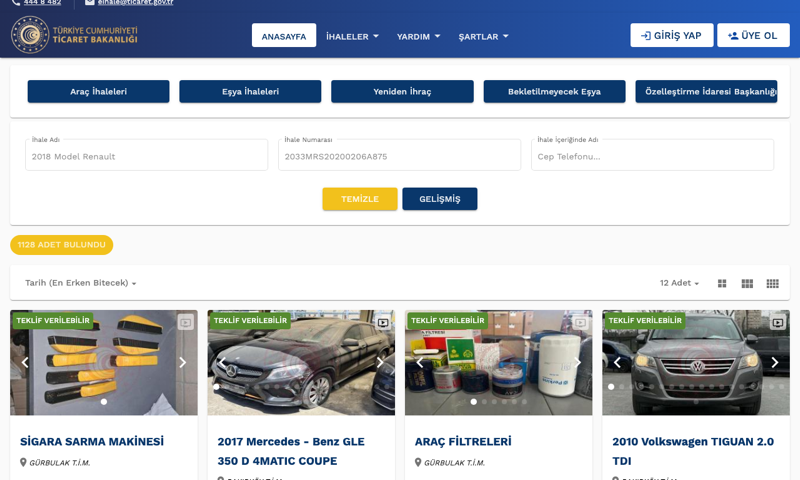
e-İhale is the online auction system of Türkiye's Ministry of Commerce (Ticaret Bakanlığı), run through its regional Liquidation Operating Directorates (Tasfiye İşletme Müdürlükleri) — twenty-one of them, from Bakırköy and Erenköy in İstanbul to Gürbulak on the Iranian border and Habur on the Iraqi. Most of what is sold has passed to the state under Turkish customs and anti-smuggling law, and each lot names its basis: 4458 sayılı Gümrük Kanunu for cargo abandoned or never cleared at customs, 5607 sayılı Kaçakçılıkla Mücadele Kanunu for goods and vehicles seized in smuggling cases. The same platform also carries a separate stream from the Privatization Administration (Özelleştirme İdaresi Başkanlığı), which sells surplus public-sector vehicles under 237 sayılı Taşıt Kanunu. It is a state disposal channel, not a marketplace for private sellers.
What you can buy
- Vehicles: 404 of the 1,128 open lots at the time of checking — passenger cars, vans and pickups (Kamyon & Kamyonet), minibuses and a handful of motorcycles, each listed with year, mileage, gearbox, engine size, photographs and an expert report (Expertiz Raporu).
- Electronics: mobile phones are the commonest item on the goods side, alongside tablets, laptops, smartwatches, headphones and circuit boards.
- Machine parts and equipment: vehicle filters, gaskets, motors, tractor spares, printing machinery and industrial instruments.
- Bulk consumer goods: clothing, footwear, bags, eyewear, toys, glass and homeware, usually as mixed seized job lots ("muhtelif eşya") rather than single items.
- Government fleet: 61 lots from the Privatization Administration — plated Fiat Doblos, Ford Transits and similar, collected from the public body that used them.
How the bidding works
Membership is free and also reachable through the e-Devlet portal, but sign-up is built around Turkish identity: the form asks for a T.C. Kimlik No, the ID card serial number and a date of birth checked against MERNİS. Companies need no separate registration — individuals authorised for the firm in the ministry's MERSİS register simply use the "Kurumsal" login. Each lot shows a viewing period (Görüş Başlangıç Tarihi) opening several days before bidding starts, then stays open to ascending online bids for three working days, or one working day for goods that cannot be stored (bekletilmeyecek eşya); the deadline is not extended. Bidding opens at 75% of the appraised sale value (satışa esas bedel) for vehicles and 50% for goods, and increment steps are set automatically by the system from that value rather than published as a table. A proxy tool, otomatik teklif, bids on your behalf up to a maximum only you can see. Before bidding you must hold enough free balance: the deposit is 10% of the satışa esas bedel, capped at 100,000 TL, paid at the counter or by internet banking at Halkbank, Vakıfbank, Ziraat Bankası or Vakıf Katılım under the "tasfiye eihale" corporate collection menu, quoting your ID or tax number. Cards are not accepted. The deposit is not tied to one lot; it sits as a free balance and comes back only when you file a refund request, to an account of your own, within seven working days of approval. Winners pay within seven days, with one chargeable seven-day extension on most lots, and collect from wherever the lot is held. Nothing is shipped.
What to check before you bid
The interface, announcements and per-lot terms (şartname) are in Turkish only. Prices are in lira with ÖTV and KDV already separated out of the bid, so no further ÖTV or KDV is charged unless the lot says so; stamp duty at 15.17 per mille is added, and some vehicles carry an extra charge (Ek Mali Yükümlülük) spelled out in the lot's description, so read it before committing. The barrier for a foreign buyer is a real one: registration is keyed to a Turkish identity number, the deposit must be paid against that number through a Turkish bank, and refunds go only to your own account. Goods sit in directorate depots across the country — İzmir, Mersin, Gaziantep, Trabzon, Van, Bursa, Kocaeli, Edirne, Ergazi in Ankara — while Privatization Administration vehicles stay with the institution that used them, so the collection address comes from the lot, not one central saleroom, and delivery only begins once a wet-signed copy of the şartname reaches the selling unit. Inspect on site where you can: stock is sold as it stands, often after long storage, mileage figures are explicitly non-binding, and sales fall outside Turkey's consumer protection law. A highest bid below 75% of the appraised value does not close the sale automatically but goes to the selling unit for a decision, and 177 of the open lots were "yeniden ihraç" — import-restricted goods that must leave the country under customs supervision within thirty days of payment.