EEAS Auction Sales
- Open to private buyers
Visit official website eeas.europa.euCompare with another platform
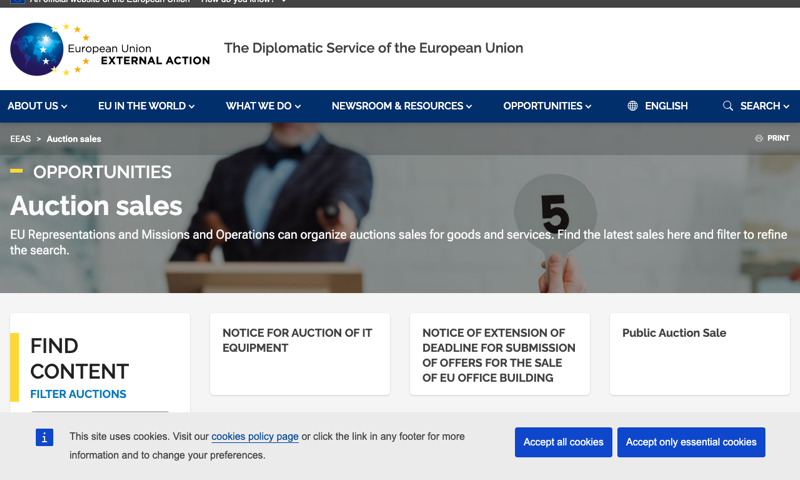
Auction Sales is the notice board of the European External Action Service (EEAS), the EU's diplomatic service, based in Brussels. It gathers sale announcements published by EU Delegations, EU Representations and EU Missions and Operations in more than forty countries — Albania, Montenegro, Georgia, Kenya, Liberia, Indonesia, India, Haiti, Hong Kong and others. The stock is the delegations' own retired inventory. The EEAS only hosts the listings; each sale is run by the delegation itself, and in some countries through a local commercial auctioneer acting for it.
What you can buy
- Delegation vehicles: a Liberian notice offered a Toyota Hilux double cab, a Fortuner and a Land Cruiser 76 hardtop as three separate lots; elsewhere Land Cruiser Prados from Malawi, Cambodia and the Kyrgyz Republic, a 2013 Mercedes E-Class from the Delegation to the Council of Europe in Strasbourg, a Toyota Previa from the Hong Kong office, and saloons such as Volvo S80, Audi A6 and Skoda Superb. Motorcycles appear too. Some lots are stated outright as not in running condition.
- IT equipment: computers, printers and other office hardware retired from delegation premises — Hong Kong sold its retired IT gear in eight lots, Montenegro put up 35 used laptops.
- Furniture and appliances: office and residential furniture, beds, mattresses, fridges and washing machines; Papua New Guinea sold "furniture and various white goods", Albania sofas, armchairs and glass tables.
- Technical installations: standby generators (Deutz and Perkins sets in Liberia, an Olympian GEH 200 in Montenegro) and alarm sets with outdoor cameras removed from compounds.
- Property: EU-owned office buildings turn up regularly — the EU office building in Haiti, office space in San Pedro, San José in Costa Rica, the former delegation office on Plot 68 in Botswana and the former EU office in Libreville, Gabon.
How the bidding works
There is no account and no online bidding. Every notice is a standalone tender with its own deadline, run by the delegation that publishes it. The most common format is a sealed-bid or “silent” auction: you e-mail to book a viewing slot, inspect on the fixed day, take the bid form, then submit one priced offer per lot — either in a sealed, marked envelope delivered to the delegation, or by e-mail with a prescribed subject line. Envelopes that arrive open or poorly closed are rejected. The other format is a live public auction held on a set date and hour, sometimes at a commercial auctioneer's premises rather than the delegation's, and Kenya has run sales where the form goes into a sealed box at the viewing site. Fees are the exception rather than the rule, but they exist: a Malawi vehicle auction charged a non-refundable entry fee plus a large refundable deposit per vehicle, forfeited if the winner failed to pay. The highest offer per lot wins, and the delegation may set a target price or refuse offers it judges too low. Winners are notified by e-mail, pay by bank transfer, cash deposit or cheque within one day to a week, and collect inside a narrow window; one Liberian sale allowed a single three-hour slot. Bids are quoted in whichever currency the notice names — EUR, USD, AED, IDR, HKD, PGK, MWK. Private individuals and companies may both bid.
What to check before you bid
Everything goes “as is, where is”, with no warranty and no liability accepted after the sale. Notices usually carry a one-line condition statement — “used and in moving condition”, “runner”, or a warning that some items need repair and cleaning — but nothing resembling an independent inspection report, so the viewing day is the only real check you get. Import duties, transfer of ownership, registration, insurance and taxes all fall on the buyer, which matters because delegation vehicles are often held duty-free under diplomatic status, so clearing that status can cost real money in the host country. Removal and transport are yours to arrange, and failing to collect can forfeit money already paid. The central list is patchy: long-expired notices from 2021 and 2022 are still on display, and the deadline filter does not cover every listing, so check the relevant delegation's own page before planning anything. And the lots are scattered across more than forty countries, mostly far from Europe, which makes cross-border bidding impractical for most of them — though Albania, Montenegro, Iceland, North Macedonia, Georgia and Strasbourg come up often enough to be worth watching.