Malta Judicial Sales register
- Official notice board
- Access not confirmed
Visit official website ecourts.gov.mtCompare with another platform
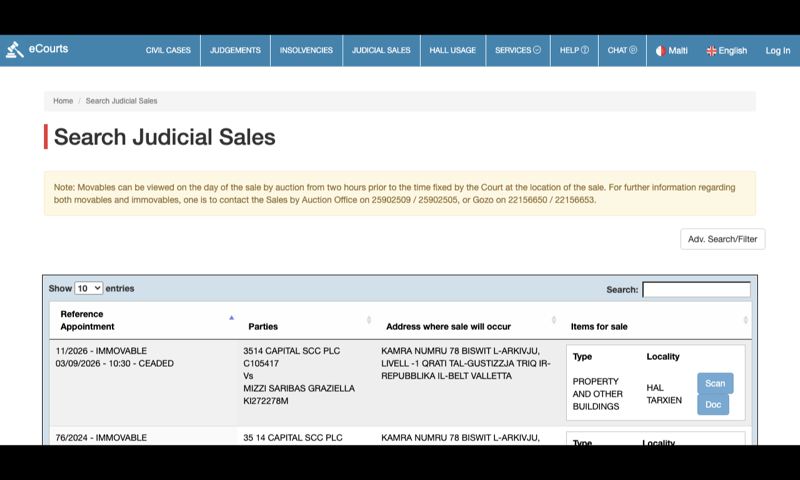
This is the register of judicial sales (subbasti) kept by Malta's courts, and it is where court-ordered sales are legally advertised. It is a register rather than a bidding platform: each entry gives the case reference, the appointment date and time, the parties, the address where the sale takes place, the type of asset and its locality, along with scanned court documents. The sales themselves are held in person, most at the Courts of Justice on Triq ir-Repubblika in Valletta, with Gozo cases handled separately.
What comes up
- Immovables (immobbli): the bulk of the register — property and buildings across the Maltese islands, sold in execution of judgments, frequently on bank claims.
- Movables (mobbli): goods seized under court warrant, listed with the place they can be inspected.
- Both Malta and Gozo: Gozo cases run through their own section of the court.
How the bidding works
There is no online bidding. You attend the appointment at the court, and the register exists so that the sale is properly advertised beforehand. Entries are marked by status — an appointment can be listed as scheduled or as ceded — so the register has to be re-checked close to the date rather than read once. Movables may be examined on the day fixed by the court, two hours before the appointed time, at the place named in the listing. The Sales by Auction section of the court answers questions on both movables and immovables, on separate numbers for Malta and for Gozo.
What to check before you bid
Attendance in person, or through someone holding a power of attorney, is the practical requirement — there is no remote bidding facility on the official channel, whatever private platforms may offer alongside it. Because these are execution sales on court judgments, what transfers is the debtor's position; on Maltese property that makes a local lawyer's search of title, ground rent and any surviving rights a precondition rather than a refinement. The register is published in Maltese, and the scanned documents are court filings rather than sales particulars, so budget for translation and for reading a case file instead of a brochure.