MBVK Árverés
- Open to private buyers
Visit official website arveres.mbvk.huCompare with another platform
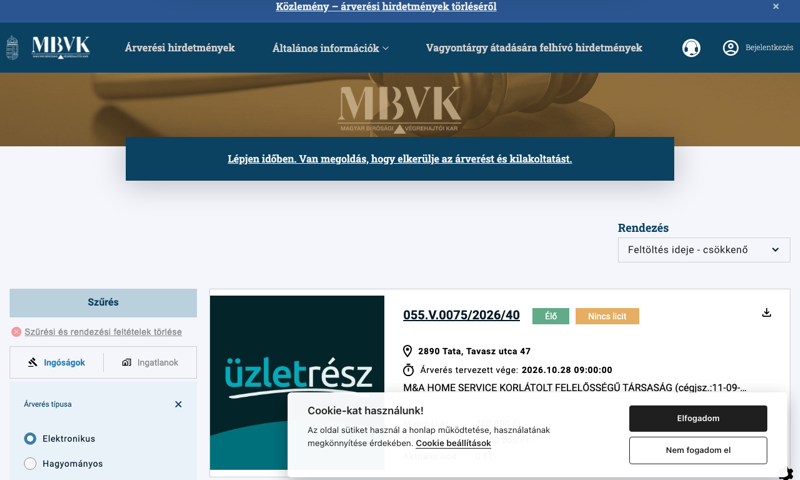
MBVK Árverés is the Elektronikus Árverési Rendszer, the national auction register run by the Magyar Bírósági Végrehajtói Kar, the statutory chamber of Hungary's court bailiffs. Every lot has been seized in a Hungarian enforcement case against a private debtor or an indebted company and is sold by the bailiff handling that file, whose office, phone, office hours and escrow account appear on the notice. In late August 2026 it held roughly 1,090 live electronic property auctions and 436 electronic movable-goods auctions, alongside about 14,000 open-ended continuous property auctions, 2,700 continuous land auctions and 195 traditional in-person movable auctions.
What you can buy
- Houses and flats: repossessed village houses in places like Ramocsaháza, Ároktő or Halmajugra, typically 60-110 m2 in poor to average condition, opening between a few hundred thousand and 10 million forint.
- Land: undeveloped building plots, one in Nyíradony opening at 28,000 HUF, plus a standing list of continuous farmland auctions covering arable, vineyard and closed-garden parcels.
- Cars and vans: around fifty live vehicle lots, the fuller ones listed with VIN and roadworthiness expiry: a 1998 Opel Astra Caravan on 276,212 km from 300,000 HUF, or a 2009 Citroen Jumper van from 1,000,000 HUF. Many others are a single line of text.
- Machinery: agricultural kit such as grain silos and dryers, and industrial gear like stainless storage tanks filed under "other"; the filter also offers industrial machines, hand tools, office machines and IT hardware, but those categories are usually empty.
- Company shares: a debtor's stake in a Hungarian Kft, usually opening at exactly 3 million HUF and making up about seventy percent of the electronic movables list.
- Household goods: furniture, artworks and jewellery in small numbers. Clothing, toys, white goods, consumer electronics and antiques have their own filters but rarely a live lot.
How the bidding works
Registration is open to anyone but not online: attend an independent bailiff's office in Hungary in person or by proxy, pay a one-off 6,000 HUF fee and show ID, a Hungarian address card and tax card, while companies add a company extract and signature specimen. Electronic bidding is timed rather than live. Movable lots run up to four stages closing 15, 30, 45 and 60 days after publication, the minimum bid falling from 75% of the opening price to 50%, 25% and finally 1%; property runs three stages at 20, 40 and 60 days, and a bid in the final five minutes extends that stage by five. Traditional movable lots are flagged "not biddable online" and are knocked down in person at a stated time and place, while continuous property and land notices sit open with no closing date. For each lot you first transfer a 10% deposit to the bailiff's escrow account and request activation at least three working days before the stage closes. The bailiff then summons the winner to sign the auction record at the office and to pay the balance into the escrow account, a process running to weeks rather than days; miss either deadline and the deposit is forfeited.
What to check before you bid
The interface, notices and bid logs are Hungarian only and prices are in forint. In-person registration and the Hungarian document list make the platform awkward from abroad without a local representative, and a purchase needing official permission, such as farmland or a foreign buyer's acquisition permit, requires that permit with the activation request. Check whether a property is sold occupied, with the debtor still living in it, or vacant, and check the ownership share, since part-shares are common and only about a third of lots are a clean 1/1. Condition notes often come from the municipal tax and valuation certificate rather than a surveyor, viewing times are usually shown as "not specified", and photos are indicative only. No lot page states VAT treatment, and the named bailiff is the only source of further detail.